Aji Verde (Peruvian Green Chili Sauce)

aji verde

Recently, I went to Sophie’s Cuban Cuisine near me and had completely forgotten how much I love their green sauce. The first time I made it, I used the food processor and didn’t really like the consistency of the sauce even though it tasted great. The Vitamix worked out better and was less cleaning, so win-win. You can use this sauce on just about anything, including meat, seafood, veggies, etc. It’s actually a nice salad dressing too!

Ingredients:

1 bunch cilantro, including stems
4 jalapenos, most seeds removed and roughly chopped
2 garlic cloves, peeled
¼ cup avocado or olive oil
1-2 tablespoons mayonnaise (optional)
Squeeze of lemon juice
½ teaspoon sea salt

1. Puree all ingredients in blender. Mayonnaise adds creaminess. If the sauce appears too thick, add water to thin it out. Refrigerate to allow flavors to meld together. It keeps fresh for about a week. Enjoy!

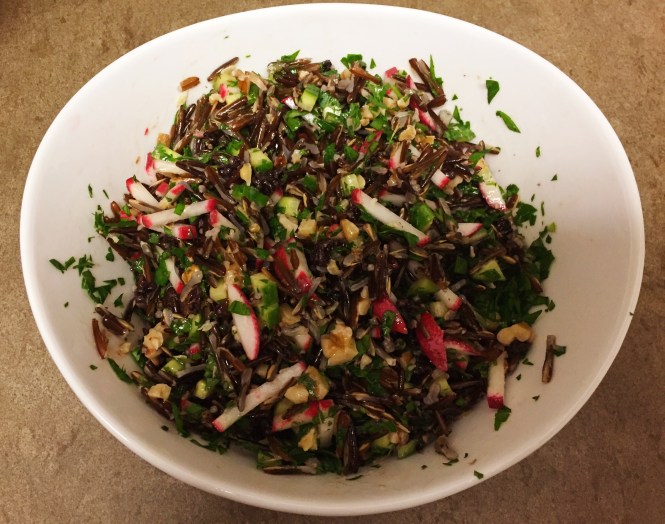
Wild Rice Salad!

wild rice salad

Wild rice isn’t actually rice, but the seed of a type of marsh grass. Similar to brown rice, it has a nutty flavor, but has more protein, fiber, iron and copper than brown rice. The addition of cucumber, radishes, and parsley to the wild rice lighten it up and make it a refreshing side dish. Enjoy!

Ingredients:

Salad:
1 cup wild rice
1 persian cucumber, chopped small
6 small radishes, julienned
½ cup currants
½ cup walnuts, chopped
½ bunch parsley, chopped
sea salt to taste

Dressing:
2 tablespoons brown rice vinegar
1 tablespoon fresh lime juice
1 teaspoon dijon vinegar
3 tablespoons olive oil
sea salt to taste

Procedure:

1. Cook wild rice according to directions and allow to cool.
2. In a large bowl, whisk together dressing ingredients.
3. Add salad ingredients to dressing and mix until evenly distributed.

Lemony Chickpea Salad!

chickpea-salad

We’ve been experiencing spring-like weather in NYC these days which puts me in a salad mood. This is a refreshing chickpea salad, using minimal ingredients and is great over crunchy chopped romaine or as a side dish or even as a topping on your avocado toast. To bulk it up for a more filling meal, you can add quinoa to the mix. Enjoy!

Ingredients:

1- 29 ounce can of chickpeas, drained and rinsed OR about 3 cups cooked chickpeas
10-12 black sicilian oil-cured olives, pitted and thinly sliced
1 lemon, zested and juiced
1 shallot, finely chopped
2 tablespoons of freshly chopped parsley
salt
pepper
olive oil

Procedure:

1. Mix the first 5 ingredients in a large bowl.
2. Lightly mash chickpeas with a fork, leaving most of the chickpeas whole.
3. Add salt, pepper, and olive oil to taste

Butternut Squash Soup!

butternut-squash-soup

I made this soup as part of our Thanksgiving feast and wanted to share the very simple recipe. Although there are few ingredients, this soup is truly delicious and perfect for autumn!

Ingredients:
1 (2-3 pound) butternut squash, peeled, seeded, and diced into 1” chunks
2 tablespoons unsalted butter or olive oil
1 medium onion, diced
6 cups chicken stock or vegetable stock
pinch of nutmeg
salt and freshly ground pepper

Directions:
1. In a large pot, melt butter or add oil. Add onion and cook until translucent, about 8 minutes.
2. Add squash and stock.
3. Bring to a simmer and cook until squash is tender, about 15-20 minutes.
4. Remove squash chunks with slotted spoon and place in blender to puree.
5. Return blended squash to pot and stir.
6. Season with nutmeg, salt, and pepper.
7. Enjoy!


Granola!

granola

One of my friends made this for me a couple of years ago and shared the recipe. It’s been a while since I’ve made it because I would consume the batches way too quickly. This time around I’m trying to exercise some self-control which is not an easy feat. It’s such a simple recipe and can be adjusted to personal tastes as well as what mix-ins you have around the house. Sunflower seeds, diced dried apricots, and pistachios would work really well in this too. This morning, I made a parfait with blackberries and raspberries. For a snack or breakfast, I like to also have it in warm almond milk. It’s really soothing and satisfying 🙂

Ingredients:
2 1/2 cups regular oats (not instant)
1/2 cup roasted coconut chips
1 cup pumpkin seeds
½ cup dried blueberries or cranberries
1 teaspoon cinnamon
1/3 cup coconut oil
1/3 cup honey or agave nectar (vegan)
1 teaspoon vanilla extract

1. Preheat oven to 325 degrees.
2. Line a large sheet tray with parchment paper or a silpat.
3. Combine oats, coconut chips, pumpkin seeds, blueberries or cranberries, and cinnamon in a large bowl.
4. Combine honey or agave, coconut oil, and vanilla extract in a measuring cup.
5. Add oil mixture to oat mixture and combine well.
6. Spread on baking sheet in an uniform layer to allow for even baking.
7. Bake 20-25 minutes, stirring once halfway. Cool completely in pan, allowing the granola to crisp up and form clusters.
8. Store in airtight container.

Spicy Thai Carrot Ribbons!

spicy thai carrot ribbons

The creaminess of the peanut butter tames the heat of the crushed red pepper flakes in this yummy sauce for gently cooked carrot ribbons. No spiralizer needed! It could easily be bulked up into an entree with the addition of edamame or some crispy tofu over jasmine rice. Enjoy!

Serves 2

Ingredients:
1 tablespoon sesame oil
1 garlic clove, minced
¼ teaspoon crushed red pepper flakes
¾ cup vegetable broth
2 tablespooons creamy peanut butter
1 tablespoon soy sauce
1 teaspoon rice wine vinegar
2 medium size carrots
thai basil
toasted sesame seeds

Directions:
1. In a large skillet over medium heat, heat the sesame oil.
2. Add minced garlic and crushed red pepper flakes and cook just until fragrant, stirring constantly.
3. Add broth, peanut butter, soy sauce, and vinegar. Increase the heat to high and stir constantly until the peanut butter melts into the sauce.
4. Reduce the heat to medium-low and cook for about 5 minutes.
5. In the meantime, use a vegetable to first peel off the skin and discard. Then shave carrots into thin ribbons.
6. Add ribbons to the pan and cook for 2 minutes. Stir to coat thoroughly in sauce.
7. Serve warm and garnish with thai basil and toasted sesame seeds.

*Follow me on Instagram for more delicious photos!*


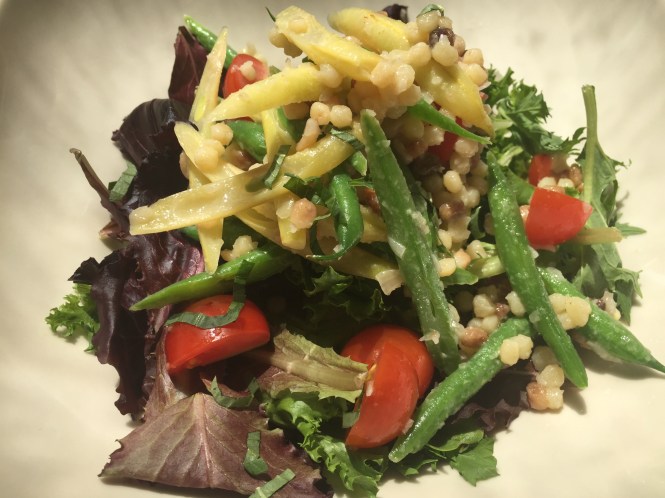
Summer Bean Salad with Fregola!

summer bean salad with fregola

Fregola is an oven-toasted Sardinian pasta, shaped like little pearls. A special pasta-making method, using bronze drawplates give it a rough, porous texture that captures sauces and dressings very well. If you can’t find fregola, you could substitute Israeli couscous. This shallot dressing is so delicious, as the shallots are cooked slowly in oil to bring out their natural sweetness. Be sure to mix in the dressing while the pasta is still warm, as it will be better absorbed. This is the perfect summer salad to bring to your next barbecue or potluck!

Ingredients:

Dressing:
2 large shallots, chopped
¼ cup avocado oil
1 tablespoon apple cider vinegar
2 tablespoons vegetable broth
1 teaspoon dijon mustard
1 teaspoon honey
¼ teaspoon salt

Salad:
1 cup fregola
½ pound green beans, trimmed and blanched
½ pound yellow wax beans, trimmed and blanched
½ cup cherry or grape tomatoes, halved
1 tablespoon chopped fresh basil
½ teaspoon salt

Directions:
1. For the dressing: Place the shallots and avocado oil in a small saucepan over low heat and cook gently until completely soft, about 15 minutes. Remove from heat and let cool to room temperature.
2. In a food processor, add the cooled shallots and oil, the apple cider vinegar, broth, mustard, honey, and salt. Pulse until the shallots are finely chopped and the dressing is thick. Set aside.
3. For the salad: Bring a medium pot of salted water to a boil over medium-high heat. Add the fregola and cook for 8-9 minutes or until cooked through. Drain well, then place in a large bowl. While the fregola is still warm, add the dressing and toss to coat. Allow the fregola to cool slightly before adding the green beans, wax beans, tomatoes, basil and salt; toss gently to coat.

fregola

Socca Flatbread!

socca flatbread

Socca originates from Provence, France and the neighboring region of Liguria, Italy. It is similar to a large pancake, but savory and naturally gluten-free. These can be topped with just about anything and are a great brunch idea. On this particular day, I was making them for breakfast, so I added an egg, ramps, arugula, and roasted tomatoes with a little balsamic drizzle. Be sure to add enough oil to the pan, so that the socca will get crispy. Enjoy!

Ingredients:
2 ¼ cups chickpea flour
2 tablespoons olive oil, plus more for cooking
Salt

1. Whisk together chickpea flour, olive oil, and 2 cups of water. Season with 2 big pinches of salt.
2. Heat an 8-inch nonstick pan over medium-high heat. Add 1-2 tablespoons of olive oil and when hot, add in about ¼ cup of the batter. Cook for 3-5 minutes, or until the bottom is crispy and the top is almost set. Carefully flip the socca and cook for another minute.
3. Transfer to plate and repeat with remaining batter.
4. Add desired toppings and serve.

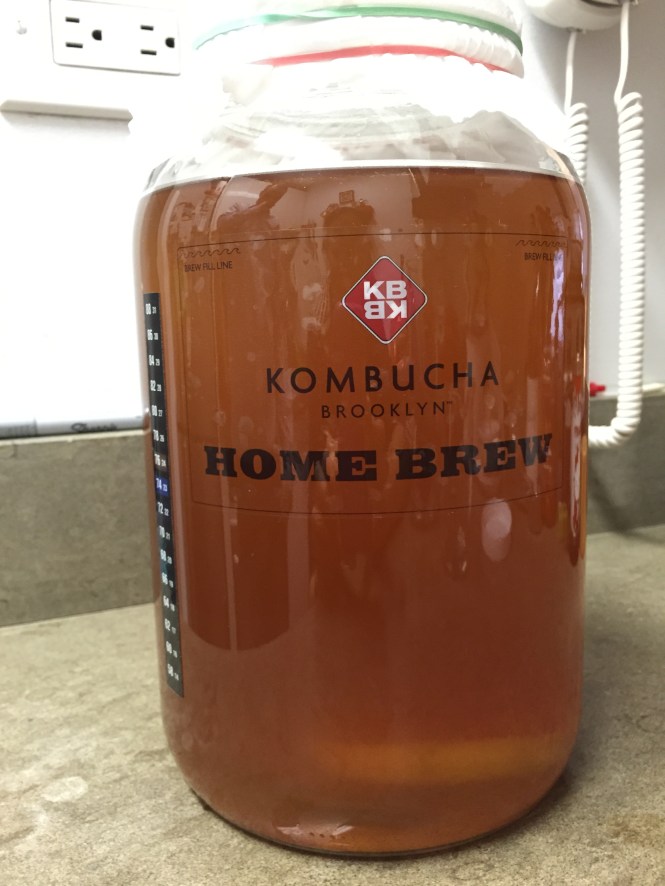
Home-brewed Kombucha!

kombucha_ready to brew

Like many other health foods, I was first introduced to kombucha while attending the Natural Gourmet Institute. We were learning about the benefits of living foods, including fresh/raw, sprouted, fermented, and dehydrated foods. Fermented foods were of particular interest to me when I learned that they introduce beneficial bacteria (probiotics) into your digestive system that have been shown to slow or reverse some diseases, aid digestion, and boost immunity. In order to nourish or feed the probiotics, it’s important to eat plenty of prebiotics, which are abundant in fruit and vegetables. Through Kombucha 101 class I also learned that it’s not just the probiotics that we benefit from, it’s also the seven different acids created through fermentation that are beneficial to the body. These acids help detoxify the body, balance a number of critical systems, and increase nutrient absorption, among other benefits. The microbes in kombucha transform the sugar and other compounds into highly accessible polyphenols and other antioxidants, B vitamins, vitamin C, organic enzymes, amino acids, and organic acids. Kombucha is a true superfood!

When I began to drink a bottle of kombucha on a daily basis, it started to get pricey at $4 or $5 a bottle, so the cost motivated me to learn how to make it myself. The SCOBY, symbiotic culture of bacteria and yeast, kind of freaked me out, but after taking the Kombucha 101 class at Kombucha Brooklyn (located in Kingston, NY), I realized that the scoby is a beautiful living thing. With each batch of kombucha, a new scoby is produced, so you can give them to friends or family to begin their own brews. It’s kind of an amazing process and I’m so happy that I’ve begun to make my own. Brewing kombucha is surprisingly easy! I found the Kombucha! book by Eric and Jessica Childs to be incredibly helpful. I purchased this kit to start: http://www.kombuchabrooklyn.com/kombucha-home-brewing-kits/kbbk-super-kit.html.

Once you start brewing, all you really need to buy are tea and sugar to continue the process. This recipe is adapted from Kombucha Brooklyn’s recipe with some of my additional notes. It takes you through the primary fermentation process. In order to carbonate your kombucha, secondary fermentation is necessary. You can also experiment with flavoring. I’ve only gone as far as putting some sliced ginger in bottles, which I enjoyed. The book provides more guidance on this process and also if you can make it to Kingston, NY, I really loved the Kombucha 101 class. It definitely made me feel more confident that I could successfully brew my own at home. They also offer more advanced classes for brewing kombucha which I may look into once I become a primary fermentation pro 🙂

Equipment:
1 gallon glass brew jar
Cloth cover and rubber bands
temperature strip
6 – 16 oz glass bottles

Ingredients:
SCOBY with starter liquid
1 cup organic evaporated cane sugar
12 oz. tea bag (black, white, and green tea blend)

Procedure:

1. Boil 4 cups of filtered water.
2. While the water is boiling, clean the brewing area, jar, hands and utensils and make sure the items are well-rinsed and free of soap residue.
3. Steep tea bag in hot water for 20 minutes, making sure to stir the tea every 5 minutes.
4. Remove tea bag and stir sugar until fully dissolved.
5. Add 2 quarts of cold filtered water to the gallon brew jar; add the sweetened tea. Stir.
6. Stick the temperature strip on the side of the brew jar and make sure the temperature is below 90 degrees before adding the scoby with its starter liquid (a temperature of 90 and above could kill the scoby)
7. Cover the jar with the cloth cover with 2 rubber bands (in case one breaks). Make sure the cover is pulled tightly over the rim of the jar to prevent contamination/fruit flies.
8. Keep the brew jar in a warm environment between 72 and 80 degrees, avoiding direct sunlight. If your home is not warm enough, you can buy a small heating mat to either wrap around or put under the jar, depending on how cool your home is.
9. Within 2-4 days, you should see a new scoby developing on the surface.
10. You should start tasting your kombucha by day 7 to see where it’s at and whether or not you want to continue fermenting. This is really a matter of personal preference. Also, remember that your kombucha will ferment faster at warmer temperatures. In order to taste, you can use a clean shot glass to gently push the scoby down and scoop a little from the surface.
11. Once your kombucha is to your taste, you’re ready to bottle. Remove the original and new scoby and 2 cups of kombucha to use for your next batches. If you don’t plan to make a new batch right away, place these in an airtight glass container in the refrigerator. The original and the new scoby can each be used to make their own batches.
12. For bottling, I used a funnel for my first batch and that was a little messy. For the second batch, I may invest in an auto siphon to avoid spillage. Place bottles in the fridge, unless you plan to continue into secondary fermentation.
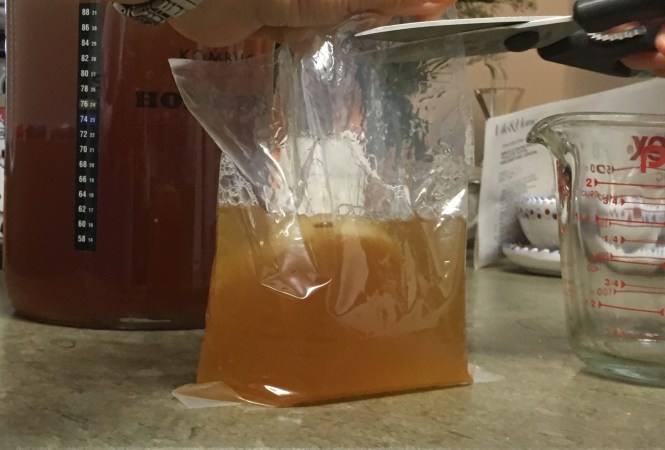
scoby and starter

If you’re buying a scoby, it will come in a plastic bag with starter liquid.

new scoby_first batch

In my first batch of kombucha, the original scoby was vertical and the new scoby developed at the surface, as it should.
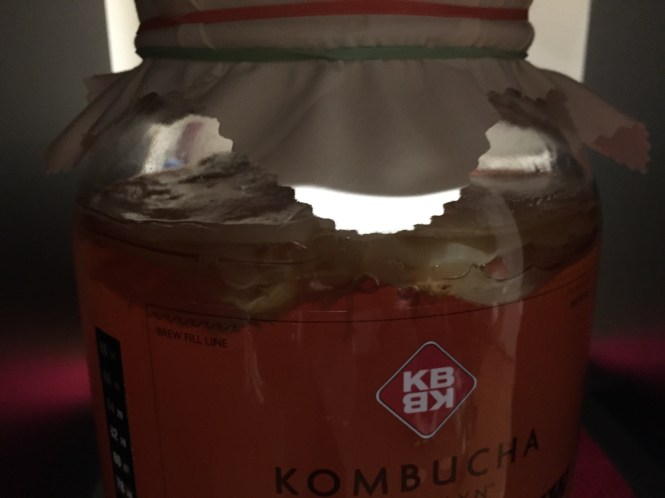
new scoby_second batch

In my second batch, I used the new scoby that was created from the original. This new scoby sat at the top and another scoby is developing right on top.
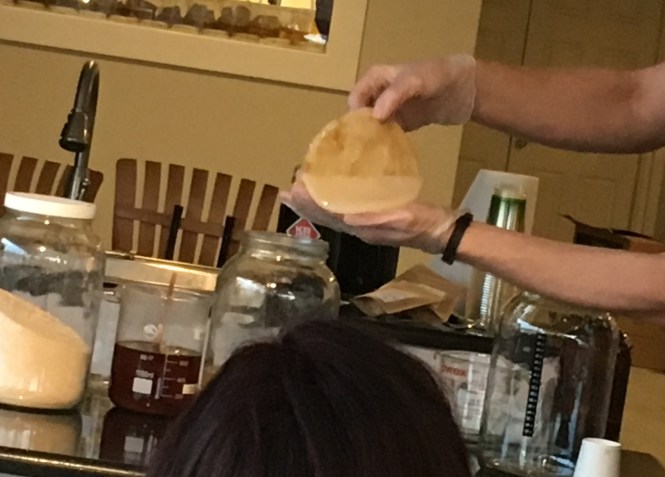
new scoby

This is a photo from class: Eric Childs at Kombucha Brooklyn is removing his picture-perfect new scoby on top from the original one. Exciting stuff!

Happy brewing!!


Shiitake-Ginger-Miso Soup!

shiitake-ginger-miso soup

I made this soup today in an attempt to beat the sniffles, but even if you’re not fighting a cold, it’s really delicious and soothing. If you prefer not to eat the ginger, you can peel and leave in large chunks so that they can easily be removed later. Boost your immune system with the help of shiitakes, garlic, and ginger in addition to the healing powers of miso. Add some leafy greens to the pot before serving for extra vitamins!

Ingredients:
1 tablespoon avocado oil or olive oil
2-3 inch piece of ginger, peeled and finely chopped
1 onion, diced
1 head of garlic, peeled and minced
3 carrots, diced
10-12 fresh shiitake mushrooms, sliced
¼ cup white miso paste
1 head of roasted garlic, peeled and mashed
Directions:
1. In a large dutch oven, heat oil over medium heat and saute ginger and onion until onion is translucent.
2. Add raw garlic and carrots; saute for a minute before adding 1.5 quarts of water.
3. Bring to a boil, add mushrooms, and lower heat, cover, and simmer for 20 minutes.
4. Remove pot from heat and add miso paste, making sure all of the miso is dissolved.
5. Add roasted garlic paste and stir well.

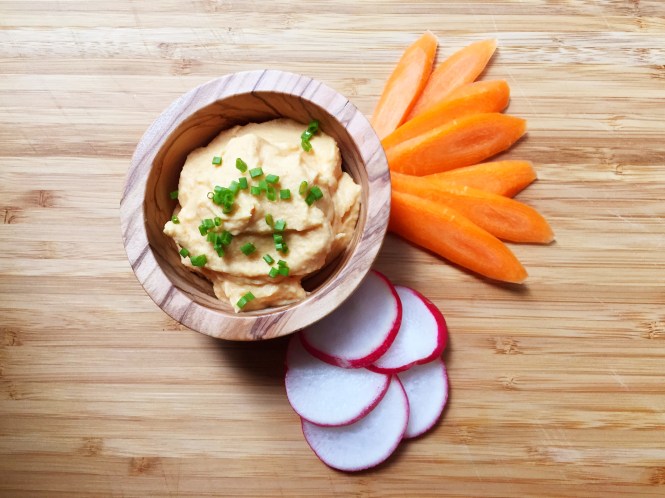
Gochujang-Red Lentil Hummus!

red lentil hummus

This week, I’ll be traveling to LA to visit some friends, so snacks for the plane ride are on my mind this weekend. Often, the airports don’t have great healthy food options or they’re pricey, so I like to pack my own if I can. Along with dark chocolate-covered espresso beans and pistachios, I will be munching on crudite with this hummus. It was my first time making hummus with red lentils, which are great because they cook up so quickly and don’t require soaking. Although I used gochujang, a staple Korean fermented red chili paste, harissa or sriracha would also work very well. This would be a perfect, vegan option to have at the Super Bowl table too!
½ cup red lentils, rinsed and picked through for stones
1 teaspoon gochujang
1 clove garlic, peeled
2 tablespoons avocado oil or olive oil
juice of ½ a lemon
salt, to taste
chives, garnish

1.Place the lentils and and 1 cup of water into a small saucepan. Place over a medium heat and bring to the boil. Turn down to a simmer and cook, stirring often, until all the water is absorbed, about 10-12 minutes. The lentils should be mushy and thick.
2. Pulse the garlic in the bowl of the food processor and then add all the other ingredients. Blend until completely smooth.
3. Enjoy!

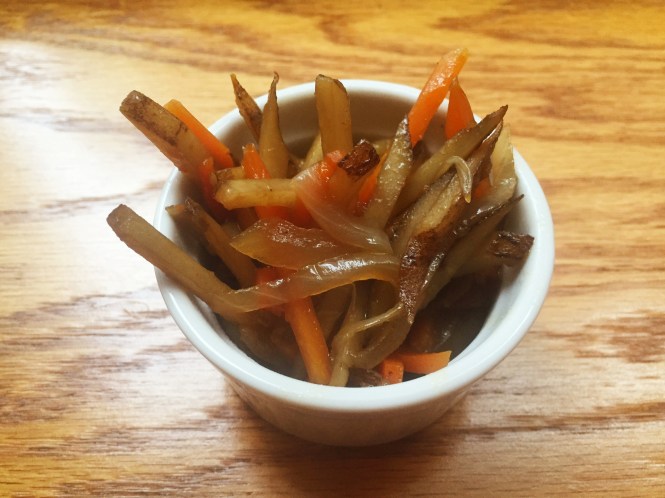
Burdock Kimpura!

kimpura

I had never heard of burdock root before the macrobiotics class at Natural Gourmet Institute. Our chef instructor said that in culinary school, he was reprimanded for peeling it, so I always remember to leave the skin on. It looks like it should be peeled with some dirt embedded in the skin, so I usually gently use a vegetable scrub brush to get any excess dirt off. The antioxidants and flavor are concentrated near the surface, so you want to make sure you preserve the skin. The root has a unique, sweet flavor that’s complemented by the savory sesame oil and shoyu. It is believed to serve as a blood purifier and strengthen the intestines. And it’s delicious!

2 tablepoons sesame oil
burdock root (about half pound), matchstick cut
medium onion, saute slice
2 carrots, matchstick cut
2-3 tablespoons shoyu or soy sauce

1. Heat a heavy skillet and coat with sesame oil.
2. Add burdock matchsticks and saute over medium heat until they no longer release their strong aroma. Stir constantly to coat the slivers evenly with oil and prevent burning.
3. Add thinly sliced onions, then the carrot matchsticks, mixing ingredients together. Saute for 1-2 minutes, and then add enough water to cover the bottom of the pan.
4. Cover pan and reduce heat, allowing to simmer for 25-30 minutes, or until the vegetables are tender, making sure the bottom of the pan does not get dry. Uncover and add shoyu or soy sauce to taste and simmer until most of the liquid is cooked out.

Jicama Nori Rolls!

nori roll

Over the summer, my friend Lucy and I fell in love with this recipe that we learned through Matthew Kenney’s raw food program. Jicama is a starchy, root vegetable that is really crunchy, like water chestnuts and a good source of vitamin C. It’s refreshing and much lighter than rice in a normal handroll. This can be enjoyed as a sushi roll as well.

For Jicama Rice:
4 cups jicama, peeled, roughly chopped
1 teaspoon sea salt
2 teaspoons rice wine vinegar
2 teaspoons honey (non-vegan) or agave (vegan)

nori sheets
leafy greens
julienne carrot
julienne beet
sunflower sprouts

1. Put jicama in food processor and pulse until there are small pieces about
the size of rice. Using a nut milk bag or mesh strainer, strain out excess
water. Toss with remaining ingredients in a bowl.
Optional: Place sushi rice on non-stick sheets and dehydrate until slightly
sticky, about 2-3 hours.

2. Cut nori sheet in half. Place flat on dry cutting board with long side facing you, shiny side down.
3. Layer leafy greens in bottom left corner. This helps keep the moisture from the jicama from making the nori sheet soggy.
4. Then spoon about a tablespoon of the jicama rice on top of the greens, flattening it out.
5. Layer the julienned vegetables and sunflower sprouts on top..
6. From the bottom left corner, carefully fold at a 45 degree angle up to meet the top of the nori sheet, forming a point at the bottom of the roll. From here, just roll towards the right side and seal with water.
7. Enjoy immediately.

Crispy Baked Tofu with Cilantro Pesto!

baked tofu with cilantro pesto

I’ve never prepared tofu in this manner before, but it was well worth all of the steps to get perfectly crispy tofu (minus the deep fryer and greasiness). The sifting of arrowroot powder before placing the tofu cubes into the oven helps to make them extra crispy and get a nice golden brown. Toasting the pine nuts for the pesto helps bring out more of the nutty flavor and the addition of lemon zest really brightens it. Enjoy!

Tofu:
12 ounce package extra-firm tofu
2 tablepoons avocado or olive oil
2 tablespoons orange juice
1 teaspoon tamari or soy sauce
2 tablespoons water
1 garlic clove, minced
½ teaspoon red pepper flakes
½ teaspoon sea salt

1/2 tablespoon arrowroot powder or 1 tablespoon tapioca flour

Pesto:
1 bunch cilantro, stemmed
1 garlic clove
1 teaspoon lemon zest

1 teaspoon lemon juice

2 tablespoons pine nuts, toasted

avocado oil
sea salt

Procedure:
1. Drain the packing water from the tofu package. Then drain the tofu by itself, placing it on a layer paper towels or on a clean, dry kitchen towel for 10 minutes.
2. Wrap the tofu in a paper towel and set it on a large plate. Then place another large plates on top of the tofu and place a heavy can of beans or tomatoes on top. Let stand for 30 minutes.
3. Unwrap the pressed tofu, wipe it dry with paper towels, and cut into 1-inch cubes.
4. In a small bowl, whisk together oil, juice, tamari, water, garlic, red pepper flakes, and salt.
5. Place tofu cubes into a shallow pan that just fits all of them and pour over the marinade.
6. Refrigerate for 4 to 8 hours, flipping tofu at least once.
7. For the pesto, add cilantro leaves, garlic, lemon zest, lemon juice, and pine nuts to the food processor. Pulse to combine and drizzle in as much avocado oil that is necessary to loosen mixture. Add sea salt to taste. Refrigerate until tofu is ready.
8. Preheat oven to 350 degrees F. Line a baking sheet with parchment paper.
9. Drain the tofu, getting rid of garlic pieces clinging to tofu, as they will burn in the oven. Place the tofu cubes in a large bowl and sift the arrowroot powder or tapioca flour over the pieces while moving the tofu around in the bowl for even distribution.
10. Place the tofu cubes in rows on the parchment paper and baking, turning the cubes 90 degrees every 15 minutes, until they are crisp and browned, about 45 minutes.
11. Toss the baked tofu with cilantro pesto and serve immediately.

Red Lentil Coconut Curry!

red lentil curry

One of my favorite entrees to order in a Thai restaurant is the red curry. I love how the heat is balanced with the creaminess of the coconut milk. The light coconut milk adds richness without the heaviness that often leaves you feeling sluggish after eating. The red lentils help make it more satisfying, as well as thicken the curry. This would be great with any veggies, especially kabocha squash or Japanese eggplant. Hope you’ll enjoy this comforting dish!

Red Lentil-Coconut Curry

2 tablespoons butter or coconut oil
1 large yellow onion, diced
3 cloves garlic, minced
1 teaspoon minced ginger
1 cup red lentils
1 tablespoon red curry paste
1 tablespoon tomato paste
1 tablespoon curry powder
1 teaspoon coriander
1 teaspoon turmeric
1/2 teaspoon cayenne powder
3 1/2 cups vegetable broth
2 cups baby spinach leaves, tightly packed
1 (13.5-ounce) can light coconut milk
cilantro, to garnish

1. Heat the butter or coconut oil in a dutch oven over medium-high heat. Add the diced onion and cook until lightly golden and soft. Add in the minced garlic and ginger, and sauté for another 2 to 3 minutes. Add in the red lentils, red curry paste, tomato paste, and spices, and cook until fragrant. Pour in the broth and bring to a boil.

2. Once the lentils and broth reach a boil, reduce to a simmer, cover, and cook for 15 minutes, or until the lentils are soft. Before serving, fold in the fresh spinach leaves, and pour in the coconut milk.
3. Serve immediately. Enjoy!

Butternut Squash-Red Lentil Soup!

butternut squash-lentil soup2

For a long time, I only bought pre-cut butternut squash due cutting my finger while using a knife to remove the peel off over Thanksgiving one year. Since then, I’ve learned that you can actually use a peeler to get the skin off more easily and safely, as long as it is not a dull peeler. The best way to do this is to cut off the ends, cut the squash in half cross-wise, and then use the peeler on each of the sections. My favorite peeler is the Kuhn Rikon Original Swiss Peeler, which we were given in culinary school, and retails for under $3 each on Amazon. It’s sharp, lightweight, and comes in a variety of bright colors. Dicing this squash brought me back to my culinary internship when I had to dice 12 quarts of butternut squash every Friday for the restaurant’s popular weekend brunch hash. Thankfully, this recipe only requires dicing one squash, so you won’t be left with orange, sticky hands 🙂

The addition of red lentils adds protein as well as thickens the soup. Red lentils have a really beautiful, coral color, before turning yellow when cooked. They are also really thin compared to other lentils, so they break down and cook quicker than other lentils. When the soup is pureed in the Vitamix, the result is really silky and delicious, with a hint of spice.

Ingredients:
2 tablespoons avocado oil
1 medium onion, minced
2 garlic cloves, minced
1 tablespoon plus 1 teaspoon minced fresh ginger
1 teaspoon brown mustard seeds
1 teaspoon cumin seeds
1/2 teaspoon turmeric
1 medium butternut squash (about 1 1/2 pounds), peeled, seeded and diced (about 3.5 cups diced squash)
1 cup red lentils, rinsed
1 ½ quarts of vegetable stock
Salt
Black pepper

Procedure:
1. Heat oil over medium heat in large, heavy soup pot. Add onion and cook, stirring often, until tender, about 5 minutes.
2. Add garlic, ginger, 1 teaspoon mustard seeds and 1 teaspoon cumin seeds and cook, stirring, until fragrant, 30 seconds to a minute.
3. Stir in turmeric, squash, red lentils and vegetable stock. Turn up heat, add salt to taste and bring to a boil.Reduce heat to low, cover and simmer 35 to 45 minutes, until squash and lentils are tender. Taste and adjust salt.
4. Purée soup using an immersion blender or, working in batches, in a blender (pull a towel down over the top of blender to avoid hot splashes). Return to pot if using blender. Add black pepper, taste and adjust salt, and heat through.

Pumpkin Mac and “Cheese”!

pumpkin mac and cheese

At this time of year, I find myself wanting everything pumpkin. Pumpkin beer, pumpkin ice cream, pumpkin pie…and the list goes on. Since I’m beginning to carbo-load for the NYC marathon this weekend, I wanted to make a pumpkin sauce for my pasta. I adapted this recipe from the Oh She Glows website and was so excited to try it out after yoga tonight. With nutritional yeast, I’m always skeptical on how it will taste, but somehow it really does add a slightly cheesy taste to the sauce, which has the ideal consistency from the arrowroot powder. The pumpkin puree is a good source of magnesium and potassium, as well as Vitamins A and K. This recipe cooks very quickly and will get dinner on the table within 30 minutes! I really enjoyed it and hope you will too 🙂

8 ounce box of pasta
1 tablespoon Earth Balance (or other non-dairy butter replacer)
3/4 cup vegetable broth
1 tablespoon arrowroot powder or cornstarch or flour
1/4 teaspoon garlic powder
6 tablespoons nutritional yeast
2 teaspoons Dijon mustard
1 cup canned pumpkin
1/2 teaspoon sea salt
freshly ground black pepper

1. Bring a large pot of salted water to a boil. Cook pasta, according to directions.

2. While pasta is cooking, add Earth balance in a pot over low-medium heat.

3. In a small bowl, whisk together broth and arrowroot powder and garlic powder until clumps are gone. Add into pot and whisk.

4. Whisk in nutritional yeast, mustard, salt, and pepper over low heat until thickened (about 5-7 minutes or so). Lastly, add in 1 cup of canned pumpkin and stir until combined and heated through.

5. Add sauce to cooked pasta and mix until pasta is evenly coated.

6. Leftovers can be stored in an air-tight container in the fridge for up to 7 days.

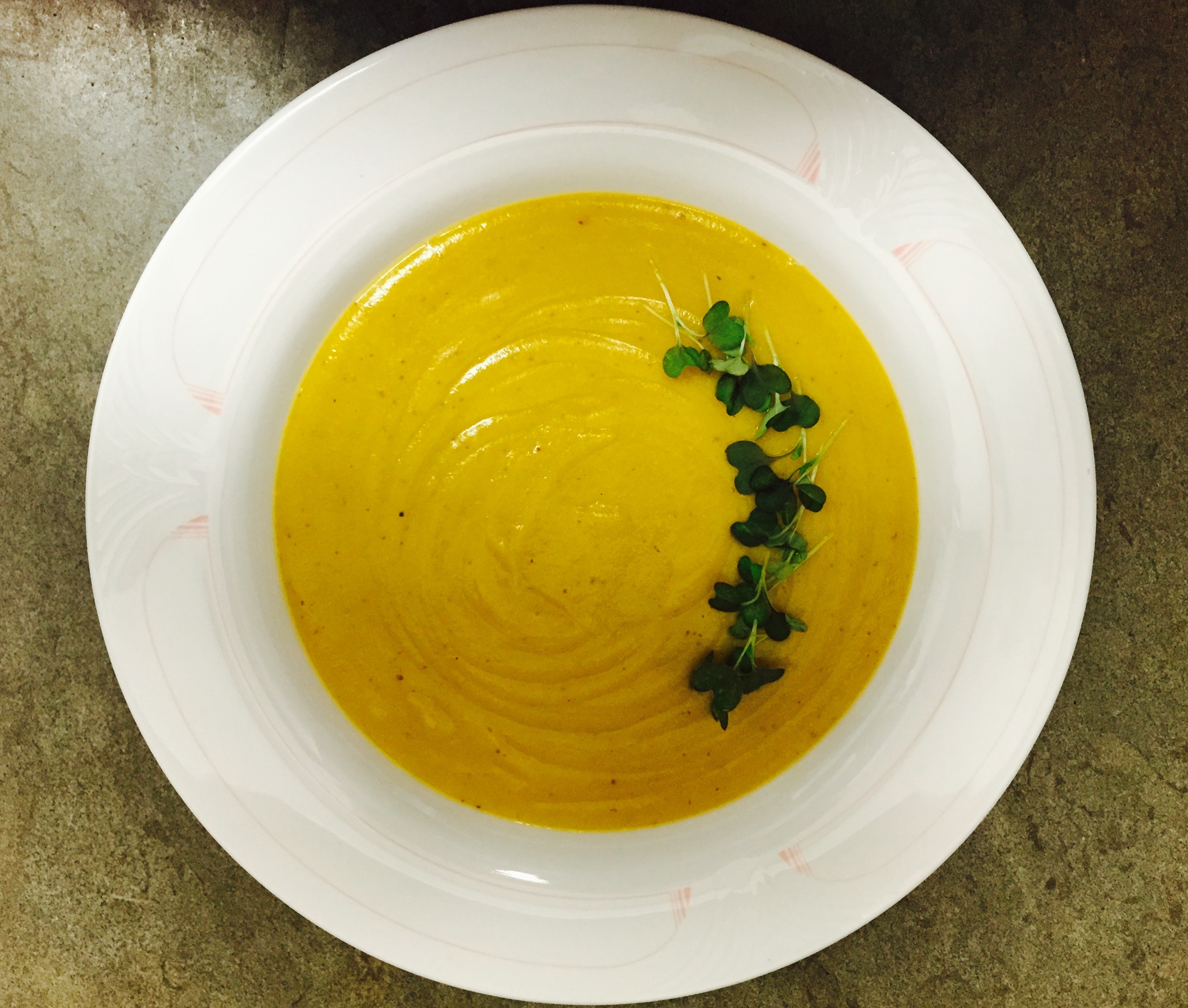
Creamy Carrot-Ginger Soup!

carrot-ginger soup

The other night, I was on my way home from a volunteer event and was hungry, but didn’t have the energy to cook anything. I stopped by my local supermarket and picked up a carton of organic cashew carrot-ginger soup which was delicious. However, I was appalled by the fact that the third ingredient was cane sugar! After that, I was determined to make my own healthier version. This uses Japanese sweet potato to both add sweetness and creaminess to the soup. Trader Joe’s recently started stocking them 🙂 I love the kick of the ginger that offsets the sweetness of the carrots and sweet potato. This soup is a good source of Vitamin A, especially from the carrots, and ginger is warming to the body, perfect for this chilly weekend! Hope you’ll cozy up to a bowl soon!

Serves 4

4 ½ cups low-sodium vegetable broth, divided
1 yellow onion, diced
3 cloves garlic, minced
1 tablespoons minced ginger
1 pound carrots, coarsely chopped
1 medium Japanese sweet potato or regular sweet potato, peeled and cut into 1-inch chunks
1 tablespoon sliced fresh chives

1. Heat 1/2 cup broth to a simmer in a medium saucepan over medium-high heat. Add onion and garlic and cook until tender, about 6 minutes, stirring occasionally.

2. Stir in ginger, carrots, sweet potato, and remaining broth and heat to a boil. Reduce to a simmer, cover and cook 25 minutes or until vegetables are tender.

3. In batches, carefully puree in a blender. Add water or broth if needed to thin to desired consistency. Reheat soup if necessary. Garnish with chives.

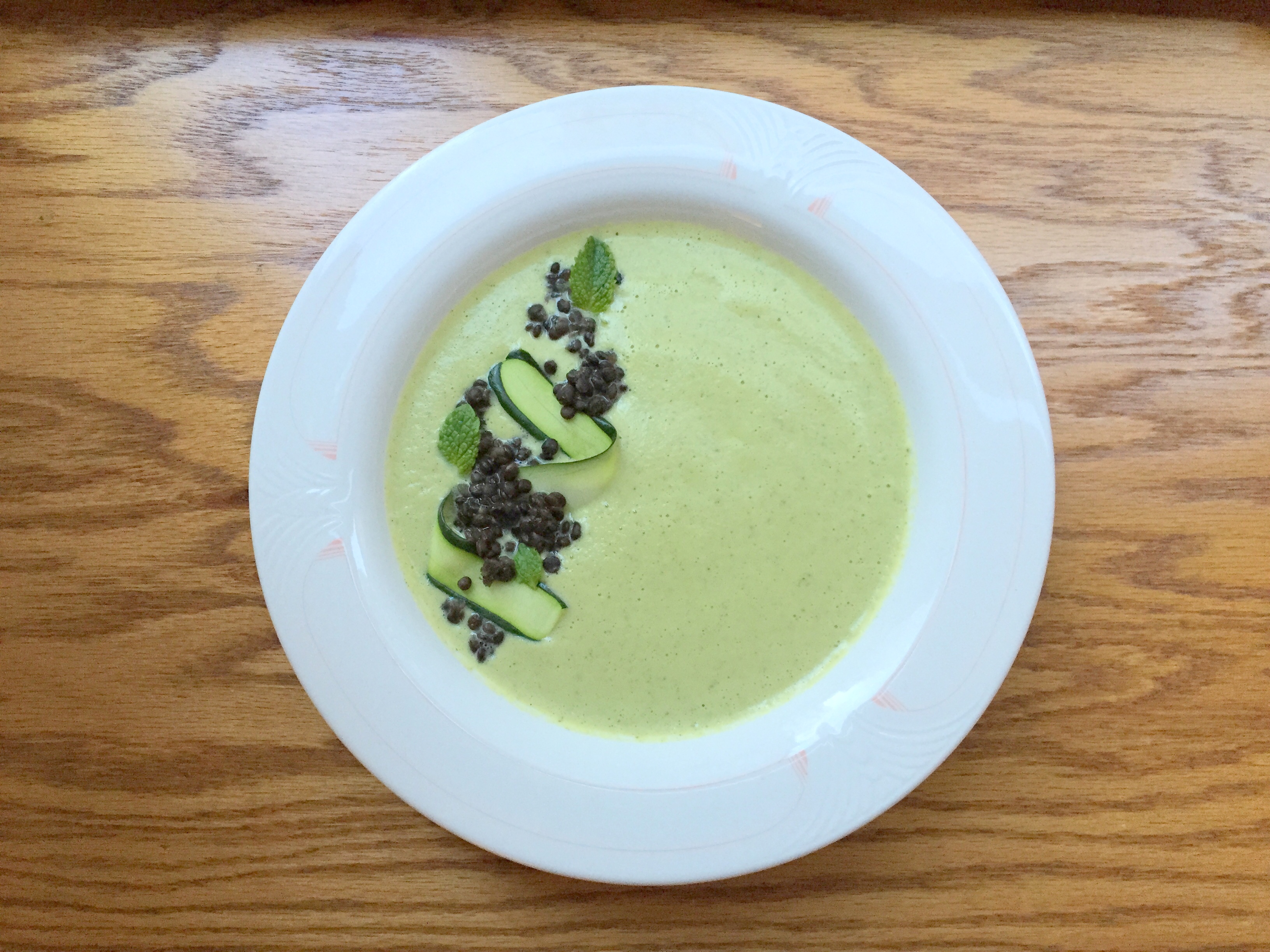
Zucchini, Almond, & Mint Soup!

zucchini almond mint soup

I think I’m in denial that we are fully into autumn and am clinging to the tastes of summer, before we’re hit with winter weather. This is perfect for those of you cleaning out your garden of the last zucchini and mint. The almonds provide creaminess to the soup, while keeping it vegan and light. Zucchini is a good source of Vitamins A and C, as well as potassium. Most of the nutrients are found in the skin, so if you can, buy organic and don’t peel it. The skin also lends a beautiful hint of green to the soup. I added beluga lentils on top in order to give it some heartiness as well as texture. Enjoy!

2 tablespoons extra-virgin olive oil
4 cloves garlic, minced
1 sweet onion, small dice
6 cups chopped zucchini (about 2-3 medium zucchini, unpeeled)
1 1/2 cups slivered almonds
5 cups vegetable stock
1 cup fresh mint
Salt and pepper, taste

1.Heat olive oil in a large pot, then add garlic and onion and sauté over low heat until soft and fragrant, stirring often. Add in chopped zucchini and almonds, and cook everything together for about 5 minutes.
2. Then cover with stock and bring to a boil. Reduce heat and simmer until zucchini is soft and tender, about 15 to 20 minutes. Let cool before blending.
3. Add fresh mint to the soup and blend in a high speed blender until smooth. Season to taste.
4. Serve the soup, hot or cold.

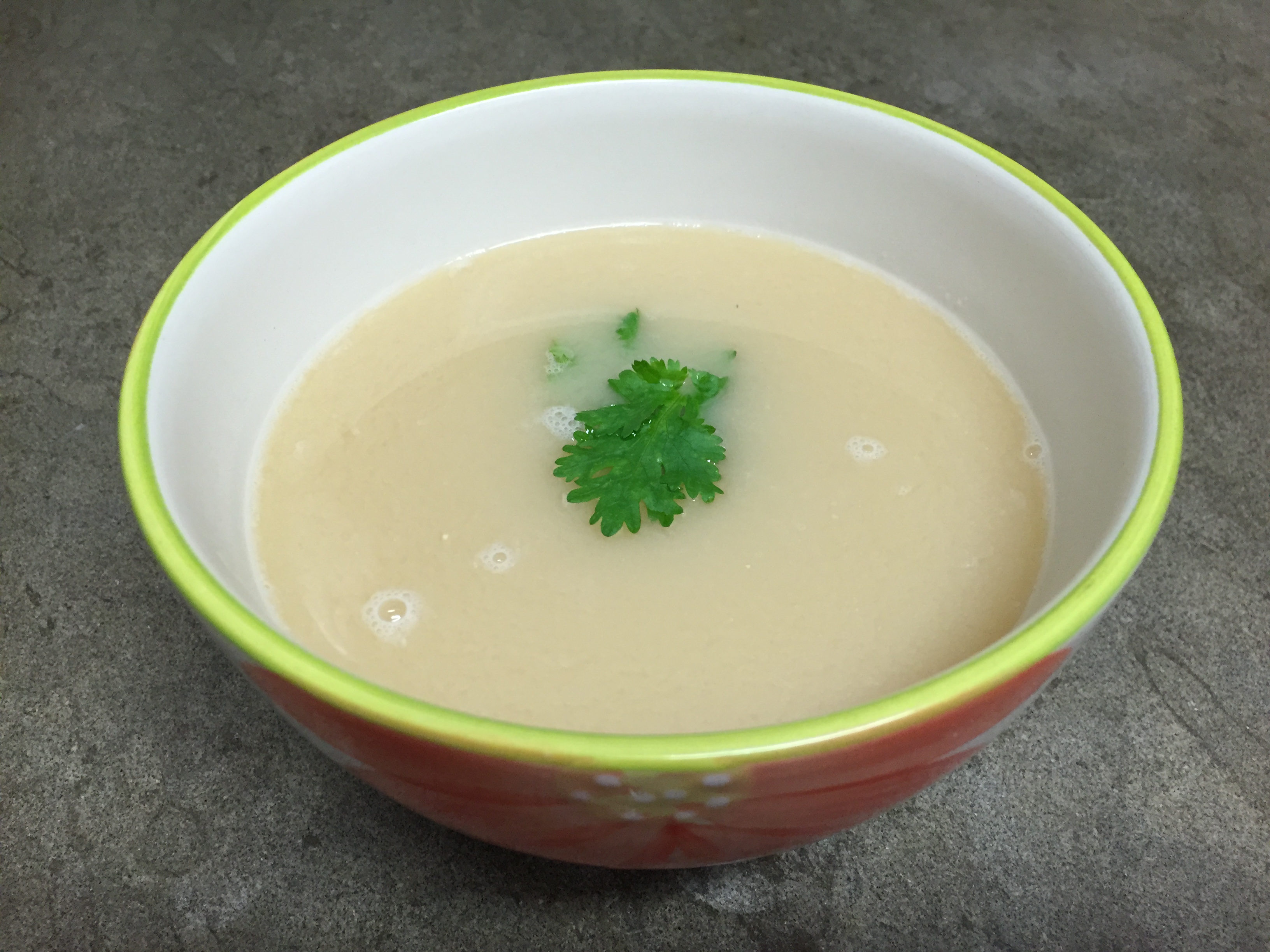
Garlic-Miso Soup!

garlic-miso soup

Happy First Day of Fall! With the change in weather, it seems that colds have been spreading quickly at the office. Every time I heard coughing and sneezing in the office today, I cringed, hoping I wouldn’t be the next one. On my way home from work, I stopped at the market for a head of garlic to make this soup. I learned the recipe in my Kitchen Pharmacy class in culinary school. It’s super simple and delicious! I would enjoy it even if I weren’t looking to boost my immunity. A single clove of garlic has 5 mg of calcium, 12 mg of potassium, and greater than 100 sulfuric compounds to kill bacteria and infection. Miso is a great concentrated source of plant protein, antioxidants, protective fatty acids, and live probiotics. Hope this soup will serve you well!

INGREDIENTS

1 head of garlic, peeled
1 quart vegetable stock or unsalted broth
1 1⁄2 tablespoons white miso
PROCEDURE
1. In medium pot, simmer garlic cloves in stock or broth for 15 minutes, partially covered.
2. Remove from heat. Puree garlic cloves in blender with about 1 cup of cooking liquid and the miso. Pour back into soup pot and stir.
3. Serve immediately. Enjoy!